Concrete Bags Calculator — How Many Bags Per Yard?
Use this concrete bags calculator to find out how many bags you need — 45 x 80 lb bags, 60 x 60 lb bags or 90 x 40 lb bags per cubic yard — worked from the manufacturer’s yield printed on the bag, not from dividing a weight. Enter your volume, pick a bag size, and it gives you the bag counts for all three sizes, the cost for each, the pallets, the dry weight to carry and the water per bag. Free, instant, no sign-up.
Concrete bags calculator
Need the full volume tool — slabs, footings, columns, steps and post holes, plus the bag-versus-truck decision? That is our Concrete Calculator: this page answers only “how many bags”, and it answers it fast.
How the concrete bags calculator counts bags
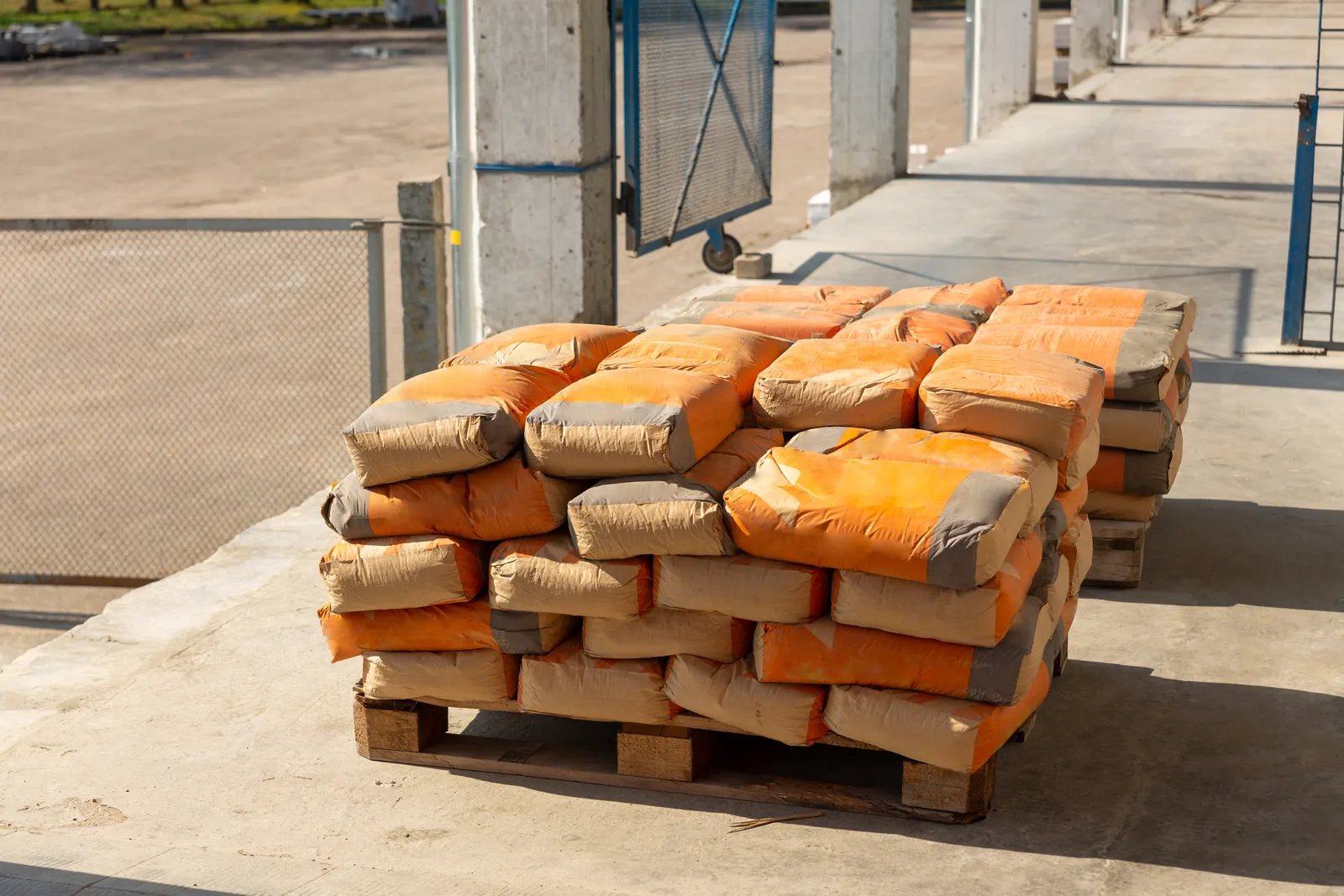
Every bag of concrete mix prints a yield — how much cured concrete one bag makes. This concrete bags calculator divides your volume by that yield. An 80 lb bag of QUIKRETE Concrete Mix yields 0.60 cubic feet; a 60 lb bag yields 0.45; a 40 lb bag yields 0.30. That is the whole method, and it is the only one that works.
The formulas, so you can check them:
- Cubic feet: cubic yards x 27. For a slab: length (ft) x width (ft) x depth (ft) / 27 gives cubic yards; multiply back by 27 for feet.
- Bags: cubic feet / yield per bag, rounded up to whole bags.
- Order volume: calculated volume x 1.10 (10% waste on flatwork; use 15% on rough, uneven ground).
- Bag counts are computed from the order volume — the counts in the tool’s “Order” line, which is what you buy.
- Coverage per bag: yield / depth (ft). An 80 lb bag covers 1.8 sq ft at 4 inches deep.
- Water: about 6 pints per 80 lb bag (about 4.5 pints for a 60 lb bag, 3 pints for a 40 lb bag).
- Dry weight to carry: bags x bag weight. A yard of 80 lb bags is 3,600 lb of carrying.
Why other calculators are wrong
Most bag calculators on the internet divide a weight. A cubic yard of cured concrete weighs about 4,050 lb (150 lb per cubic foot x 27), so they do 4,050 / 80 = 51 bags — 6 bags too many, about 13% over. The dry-weight version is worse: bagged mix is about 2,700 lb per yard dry, so 2,700 / 80 = 34 bags — 11 bags too few, and a slab that runs out halfway through the pour.
Both are wrong for the same reason: a bag of mix does not become 80 lb of concrete — part of its weight is water added at mixing, and its yield is measured in volume. The only correct number is the manufacturer’s yield printed on the bag: 0.60 cubic feet for an 80 lb bag.
What to order
- Bags: the “Order” line of the tool — the 10%-waste count, in your bag size. For a 1 yard job that is 50 x 80 lb bags (or 66 x 60 lb, 99 x 40 lb). Buy the order count, not the calculated count.
- Pallets: 42 x 80 lb bags per pallet. A one-yard order is 2 pallets (50 / 42 rounds up to 2).
- Water: about 6 pints per 80 lb bag — 50 bags take 300 pints (37.5 gallons) of clean water. Too much water weakens the mix; measure it, don’t guess.
- When to switch to ready-mix: below about 1 yard, bags win; above it, a truck is usually cheaper — see the breakeven table below for the exact crossover.
- Full project tool: if this is a slab, footing or post-hole job rather than a simple volume, use the full Concrete Calculator for the pour — this page is the count, that page is the project.
Concrete bag prices in 2026 — planning ranges, not quotes
All prices below are 2026 planning ranges, not quotes — retail, per bag and per cubic yard.
- 80 lb bag: $4.50–$6.00 (default $5.25) — 45 bags per yard: $203–$270.
- 60 lb bag: $3.50–$5.00 (default $4.25) — 60 bags per yard: $210–$300.
- 40 lb bag: $2.50–$3.50 (default $3.00) — 90 bags per yard: $225–$315.
- Bagged concrete, per yard: $270–$290/yd3 (RemodelCalculators, 2026) — a planning cross-check against the per-bag arithmetic.
- Ready-mix: $125–$195/yd3 + a short-load fee of $50–$150 (fee applies under about 1–2 yards).
Bag yields — how many bags per cubic yard
| Bag size | Yield per bag | Bags per cubic yard |
|---|---|---|
| 80 lb | 0.60 ft3 | 45 |
| 60 lb | 0.45 ft3 | 60 |
| 50 lb | 0.375 ft3 | 72 |
| 40 lb | 0.30 ft3 | 90 |
Coverage per bag — square feet at each depth
| Bag size | At 2 in deep | At 4 in deep | At 6 in deep |
|---|---|---|---|
| 80 lb | 3.6 sq ft | 1.8 sq ft | 1.2 sq ft |
| 60 lb | 2.7 sq ft | 1.35 sq ft | 0.9 sq ft |
| 40 lb | 1.8 sq ft | 0.9 sq ft | 0.6 sq ft |
Bagged vs ready-mix — where the breakeven sits
| Volume | Bags (80 lb) | Bagged cost ($6/bag) | Ready-mix cost ($125–$195/yd3 + $100 fee) | Verdict |
|---|---|---|---|---|
| 0.25 yd3 | 13 | $78 | $134–$154 | Bags win |
| 0.5 yd3 | 25 | $150 | $169–$207 | Bags win |
| 0.75 yd3 | 38 | $228 | $203–$261 | Roughly even — the breakeven |
| 1.0 yd3 | 50 | $300 | $238–$315 | Ready-mix wins at the low end |
| 2.0 yd3 | 99 | $594 | $375–$529 | Ready-mix wins |
Worked examples
Test 1 — 1 cubic yard. The concrete bags calculator gives: calculated volume 1.00 yd3 (27.0 ft3). Bags for the calculated volume: 27.0 / 0.60 = 45 x 80 lb; 27.0 / 0.45 = 60 x 60 lb; 27.0 / 0.30 = 90 x 40 lb. Order volume at 10% waste: 1.10 yd3 (29.7 ft3) — bags to order: 29.7 / 0.60 = 49.5, rounded up = 50 x 80 lb; 66 x 60 lb; 99 x 40 lb.
Cost at the default prices for the calculated volume: 45 x $5.25 = $236 (80 lb route); 60 x $4.25 = $255; 90 x $3.00 = $270. Retail ranges: 45 x $4.50–$6.00 = $203–$270; 60 x $3.50–$5.00 = $210–$300; 90 x $2.50–$3.50 = $225–$315. Published band check: 1.00 yd3 x $270–$290 = $270–$290. Dry weight to carry (calculated volume, 80 lb bags): 45 x 80 = 3,600 lb. Pallets: 45 / 42 rounds up to 2.
Test 2 — slab 10 x 10 ft, 4 in deep. Calculated volume = 10 x 10 x (4/12) = 33.3 ft3 = 1.23 yd3. Order volume at 10% waste = 1.36 yd3 (36.7 ft3). Bags to order: 36.7 / 0.60 = 61.2, rounded up = 62 x 80 lb; 36.7 / 0.45 = 81.6 = 82 x 60 lb; 36.7 / 0.30 = 122.3 = 123 x 40 lb. Cost, 80 lb route: 62 x $4.50–$6.00 = $279–$372; via the published band: 1.36 x $270–$290 = $367–$394. Dry weight: 62 x 80 = 4,960 lb. Pallets: 62 / 42 rounds up to 2. Water for 62 bags: 62 x 6 pints = 372 pints (46.5 gallons).
Mistakes to avoid
- Dividing weight instead of using yields. 4,050 / 80 = 51 bags — 6 too many. The yield on the bag is the only correct number.
- Forgetting the 10% waste (flatwork) or 15% (rough, uneven ground). A flatwork pour always loses some to uneven ground, spillage and form leaks.
- Mixing more than you can place before it sets. Bagged concrete starts to set in about an hour — mix in batches you can screed and finish before it stiffens.
- Wrong water. Too much water weakens the mix — about 6 pints per 80 lb bag, measured, never a hose blast. Add water a little at a time until the mix is workable.
Frequently asked questions
How many 80 lb bags per yard?
45 — one cubic yard is 27 cubic feet, and an 80 lb bag yields 0.60 cubic feet. With 10% waste, order 50.
How many 60 lb bags per yard?
60 — a 60 lb bag yields 0.45 cubic feet. With 10% waste, order 66.
How many 40 lb bags per yard?
90 — a 40 lb bag yields 0.30 cubic feet. With 10% waste, order 99.
Why do other calculators say more?
They divide weight: a yard of cured concrete weighs 4,050 lb, so 4,050 / 80 = 51 bags — 6 too many. Only manufacturer yields are correct, which is what this concrete bags calculator uses.
How many bags for a 10×10 slab at 4 in?
1.23 yd3 + 10% = 1.36 yd3 = 36.7 cu ft, which is 62 x 80 lb bags (or 82 x 60 lb, 123 x 40 lb).
Can I pour concrete in cold weather?
Yes, but only with protection once temperatures drop. ACI 306 defines cold-weather concreting as work done when air is at or expected below 40°F during the protection period. Below 40°F, hydration can almost stop, and an early freeze can cut final strength by up to about 50%. Never pour on frozen ground. Thaw the subgrade and clear frost, snow and ice from forms and rebar first, or the ground settles unevenly as it thaws and the slab cracks. Keep the concrete at least 55°F as placed for thin sections, hold it at 50°F or above for the first 48 hours, and cover it with insulating blankets for at least 3 days, until it reaches about 500 psi. In Lubbock, November daytime highs are usually in the 60s and fall 2026 has had no freeze yet, so most pours are fine. These steps are for a cold snap or an overnight freeze.
Related tools
Concrete Calculator | Cubic Yard Calculator | Gravel Calculator
Sources and further reading
QUIKRETE Concrete Mix 1101 data sheet (revised Oct 2022) · Sakrete · BuildEstimatory 2026 · RemodelCalculators 2026 · calcsummit.com · 4calculators.com · ASTM C387.
This concrete bags calculator was last reviewed on Nov 9, 2026. Prices are 2026 planning ranges, not quotes — check the shelf price and the yield printed on the bag you buy before ordering. Spotted a mistake or a price that has moved? Tell us and we will check it and correct the page.
One last check before you load up: run this concrete bags calculator with your real volume — then read the yield printed on the bag, not the weight. The yield is the difference between 45 bags and 51, and between a finished slab and a half-finished one.