Sand Calculator — How Much Sand Do You Need?
Cubic yards, tons and bags — by sand type and depth.
Paver bedding, concrete, mason and play sand | 50 lb bags | 2026 prices
Sand Calculator
Paver bedding is exactly 1 inch, screeded level. A sandbox is usually 6–12 inches deep. Levelling low spots is usually 1–2 inches.
Bulk sand is $25–$60 per cubic yard in 2026.
Most bagged sand comes in 50 lb bags. If the bags at your store weigh something else, enter that weight here.
Free — no sign-up.
Quick answer: A 200 sq ft paver bed at 1 inch deep needs 0.62 cubic yards of sand — order 0.68 cubic yards with the usual 10% waste (37 × 50 lb bags, about 0.92 tons). Sand weighs 1.35 tons per cubic yard dry. Use the sand calculator above to check your own numbers.
How we check our math — reviewed November 9, 2026. Every formula is worked by hand against the US customary definition (National Institute of Standards and Technology) and the shared density table used across this site — dry sand 1.35 tons per cubic yard, 2,700 lb per yard, 54 × 50 lb bags per yard. Found a mistake? Tell us — we check every correction report and fix verified errors.
Rule of thumb: 54 × 50 lb bags make one cubic yard of dry sand. One yard covers 324 sq ft at 1 inch deep, or 54 sq ft at 6 inches. Do not order by the bag count alone — check the volume first, then work the bags out from it.
A 200 sq ft paver bed at 1 inch deep needs 0.62 cubic yards of sand — order 0.68 cubic yards with the usual 10% waste allowance. That is 37 × 50 lb bags, or about 0.92 tons dry. This sand calculator works out yards, tons and bag counts, so you can order the right amount for pavers, a sandbox or a concrete job.
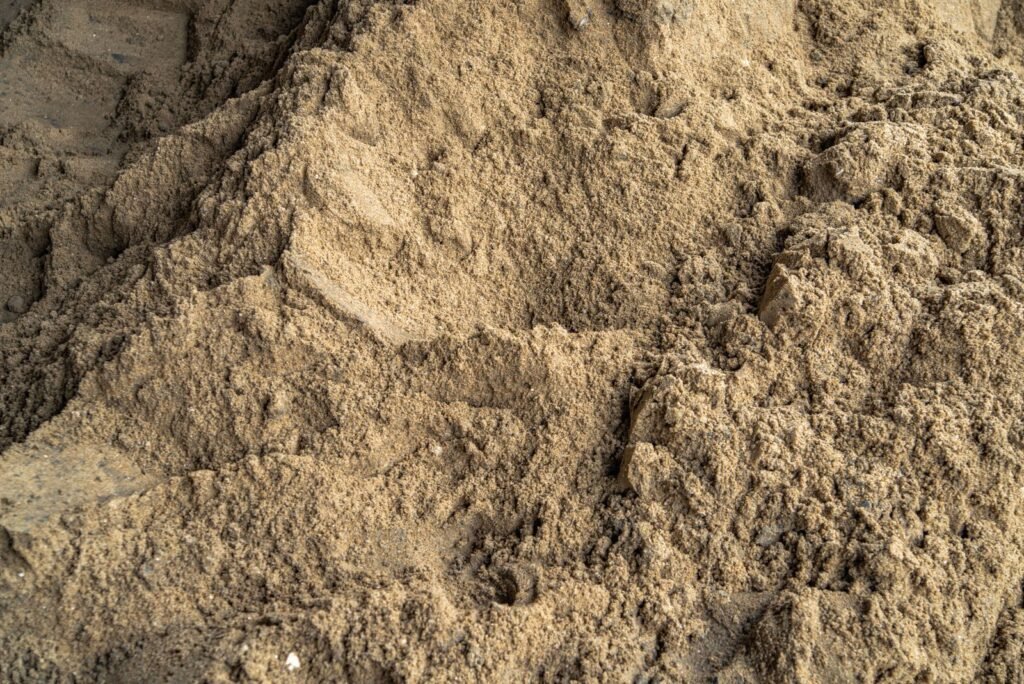
Volume notice: Sand is sold by volume, not by weight. A cubic yard of dry sand weighs about 1.35 tons (2,700 lb). Damp sand weighs more per yard, but you still order it by the yard — so work from the volume, not the scale.
How the sand calculator works
The formula is the same as for any volume: cubic yards = length × width × depth in feet, divided by 27. In inches, cubic yards = area in square feet × depth in inches ÷ 324. The sand calculator divides the volume in cubic feet by 27 to get the measured yardage, then adds your waste allowance — 10% is the usual amount — for the order volume. It converts the order volume to tons at 1.35 tons per cubic yard (dry sand), and to bags using the weight of the bag you enter. Use the sand calculator above to check your own numbers.
How the bag count works: dry sand weighs 2,700 lb per cubic yard (1.35 tons). A cubic yard is 27 cubic feet, so dry sand weighs 2,700 ÷ 27 = 100 lb per cubic foot. A 50 lb bag therefore holds about 50 ÷ 100 = 0.5 cubic feet, and a cubic yard takes 27 ÷ 0.5 = 54 bags. If the bags at your store weigh something else, enter the bag weight in the calculator — it works the bags out from the same 100 lb per cubic foot figure.
Worked example — paver bedding
A paver bed 20 ft long and 10 ft wide at 1 inch deep. Area: 20 × 10 = 200 sq ft. Measured volume: 200 × 1 ÷ 324 = 0.62 yd³ (16.7 ft³). Order volume: 16.7 ft³ × 1.10 = 18.3 ft³, which is 18.3 ÷ 27 = 0.68 yd³. Tons: 0.68 × 1.35 = 0.92 tons. Bags: 0.68 yd³ × 54 = 36.7, rounded up to 37 × 50 lb bags; without the waste allowance, the volume alone is 34 bags. Cost at $40 per cubic yard: 0.68 × $40 = $27, in the 2026 range of $17–$41.
Worked example — sandbox
A sandbox 6 ft by 6 ft, filled 6 inches deep with play sand. Area: 6 × 6 = 36 sq ft. Measured volume: 36 × 6 ÷ 324 = 0.67 yd³ (18 ft³). Order volume: 18 ft³ × 1.10 = 19.8 ft³, which is 19.8 ÷ 27 = 0.73 yd³. Tons: 0.73 × 1.35 = 0.99 tons. Bags: 0.73 × 54 = 39.4, rounded up to 40 × 50 lb bags.
Which sand for which job
Not all sand is the same, and the wrong one causes problems that only show up after the job is done. Pick by the job, not by whatever is cheapest at the yard.
| Sand type | Best for | Why |
|---|---|---|
| Paver bedding sand | Paver bedding | Coarse, angular grains lock together and compact firm under pavers. Screed to exactly 1 inch. |
| Concrete sand | Mixing concrete, mortar beds | Coarse and washed — the same sand a ready-mix plant uses in its mix. |
| Mason sand | Mortar, pointing, levelling | Fine and smooth; spreads easily and gives a neat joint. |
| Play sand | Sandboxes, play areas | Washed and fine; soft underfoot. Do not use it under pavers — it is too fine to lock or compact. |
Depth by project
| Project | Depth |
|---|---|
| Paver bedding | 1 in (screeded) |
| Sandbox | 6–12 in |
| Levelling a low spot | 1–2 in per pass |
| Levelling layer under a paver base | 1 in |
Coverage per cubic yard by depth
| Depth (inches) | Sq ft per yard |
|---|---|
| 1 | 324 |
| 2 | 162 |
| 3 | 108 |
| 4 | 81 |
| 6 | 54 |
| 8 | 41 |
| 12 | 27 |
Bags per cubic yard
Based on dry sand at 100 lb per cubic foot. A 50 lb bag holds about 0.5 cubic feet.
| Bag weight | Cubic feet per bag | Bags per cubic yard |
|---|---|---|
| 50 lb | 0.5 ft³ | 54 |
| 40 lb | 0.4 ft³ | 68 |
| 60 lb | 0.6 ft³ | 45 |
| 25 lb | 0.25 ft³ | 108 |
Waste allowance by project type
| Project type | Extra to order |
|---|---|
| Paver bedding | +10% |
| Sandbox | +10% |
| Levelling uneven ground | +10–15% |
| First time ordering | +10% |
Texas note
In West Texas, a bare sand bed does not sit still — the wind ripples it and can blow it out of the screed. Screed bedding sand and lay the pavers the same day, and keep the bed damp in dry heat so it holds its shape until the pavers go down. Play sand in an open box dries out and blows too, so keep it covered when it is not in use. Prices move with haul distance, so the $25–$60 per cubic yard bulk range is a 2026 planning range, not a quote.
Frequently asked questions
How many 50 lb bags of sand are in a cubic yard?
54. Dry sand weighs 2,700 lb per cubic yard, or 100 lb per cubic foot, so a 50 lb bag holds about 0.5 cubic feet and a yard takes 27 ÷ 0.5 = 54 bags. If your bags weigh 40 lb, the same yard takes 68 of them.
How much sand do I need for pavers?
Bedding sand goes down exactly 1 inch deep and screeded level, so work out the area and divide by 324. A 200 sq ft patio needs 0.62 cubic yards measured — order 0.68 cubic yards (37 × 50 lb bags). Run it through the sand calculator above with a depth of 1 inch, and check the base gravel too — the Gravel Calculator works out the base under the sand.
Can I use play sand under pavers?
No. Play sand is fine and rounded, so it does not lock together or compact. Under pavers it shifts, and the pavers settle unevenly. Use bedding sand (coarse concrete sand) for the 1-inch screeded bed, and keep play sand for the sandbox.
How deep should paver bedding sand be?
Exactly 1 inch, screeded level, and no more. Thicker sand compacts unevenly and the pavers sink. The base underneath — 4 inches of compacted gravel for a patio, 6 inches for a driveway — does the load-bearing; the sand only levels the pavers. The Gravel Calculator works out the base yardage.
How much does a cubic yard of sand weigh?
About 1.35 tons dry (2,700 lb). Damp sand weighs more, because water adds weight without adding much volume — another reason to order by volume. A 50 lb bag is about 0.5 cubic feet.
How much is a yard of sand in 2026?
Bulk sand is usually $25–$60 per cubic yard, plus $50–$150 for delivery when you tick it in the calculator. Bagged sand costs far more per yard than bulk, so for anything over about 2 cubic yards, bulk delivery usually works out cheaper.
Related tools
Try the Cubic Yard Calculator for any material by volume, the Gravel Calculator for the base under a paver bed, the Topsoil Calculator for lawns and beds, and the Paver Calculator — it works out pavers, base gravel and bedding sand for one patio in a single pass.
Sources and methodology: The 27 cubic feet in a cubic yard is the US customary definition (National Institute of Standards and Technology). Dry sand density of 1.35 tons per cubic yard (2,700 lb) and 54 × 50 lb bags per yard are the shared density table values used across this site. Prices are 2026 US planning ranges.
Calculation notice: Results are estimates for planning and ordering. Actual volume depends on how the ground is shaped, compaction, and the material delivered. All prices are 2026 planning ranges, not quotes.
Need a pro in Lubbock?
If you are in Lubbock, TX and would rather have the sand delivered and spread than do it yourself, see landscaping and lawn care services. This sand calculator above still tells you how much you need, so you can check any quote against your own numbers.