Sod Calculator — How Much Sod Do You Need?
Rolls, pallets and cost — for Bermuda and buffalo grass.
Rectangle, circle or total area | 10% cutting waste | 450 sq ft per pallet | 2026 prices
Sod Calculator
Grass type changes the notes only — the maths is the same for both.
Sod is $0.30–$0.85 per sq ft in 2026.
Free — no sign-up.
Quick answer: A 1,000 sq ft Bermuda lawn needs 1,100 sq ft of sod — 110 rolls or 3 pallets — at a 2026 cost of $330–$935 for materials. Measure length × width, or type the total for an L-shaped lawn. Use the sod calculator above with 10% waste, or 15% for a curved or sloped lawn.
How we check our math — reviewed November 9, 2026. Every formula is worked by hand against the US customary definition (National Institute of Standards and Technology) and the shared density table used across this site — 1 pallet about 450 sq ft, 1 roll about 10 sq ft. Found a mistake? Tell us — we check every correction report and fix verified errors.
Rule of thumb: One roll covers about 10 sq ft and one pallet about 450 sq ft — 45 rolls to a pallet. Measure in feet, multiply length × width, and add 10% for cutting waste (15% for curves and slopes).
That’s about 168 slabs (at ~2.67 sq ft each) if your supplier sells slabs.
A 1,000 sq ft Bermuda lawn needs 1,100 sq ft of sod with the usual 10% cutting waste — 110 rolls, or 3 pallets. That runs $330–$935 at 2026 material prices. This sod calculator works out rolls, pallets and cost for a new lawn of any shape.
Area notice: Sod is sold by the pallet and the roll, not by the yard. Order by the square foot, and check the pallet count before you pay — one pallet is about 450 sq ft, so a few extra rolls can tip you into another pallet.
How the sod calculator works
Measure the area in square feet. For a rectangle, length × width; for a circle, π × (diameter ÷ 2)²; for an L-shaped lawn, add the rectangles and type the total. The sod calculator multiplies the measured area by 1.10 for the usual 10% cutting waste — 1.15 for a curved or sloped lawn — to get the order area. It divides the order area by 10 sq ft for rolls and by 450 sq ft for pallets, rounding both up, and multiplies by your price for the cost. Use the sod calculator above to check your own numbers.
Worked example — rectangular lawn
A rectangular lawn 50 ft by 20 ft. Area: 50 × 20 = 1,000 sq ft. Order area: 1,000 × 1.10 = 1,100 sq ft. Rolls: 1,100 ÷ 10 = 110 rolls. Pallets: 1,100 ÷ 450 = 2.44, rounded up to 3 pallets. Cost at $0.55 per sq ft: 1,100 × $0.55 = $605, in the 2026 range of $330–$935.
Worked example — L-shaped lawn
An L-shaped lawn totalling 800 sq ft. Order area: 800 × 1.10 = 880 sq ft. Rolls: 880 ÷ 10 = 88 rolls. Pallets: 880 ÷ 450 = 1.96, rounded up to 2 pallets. Cost: 880 × $0.30–$0.85 = $264–$748.
Waste allowance by lawn shape
| Lawn shape | Extra to order |
|---|---|
| Square or rectangular | +10% |
| L-shaped | +10% |
| Curved edges | +15% |
| Sloped lawn | +15% |
| Lots of small beds and paths | +15% |
Bermuda vs buffalo grass
| Bermuda grass | Buffalo grass | |
|---|---|---|
| Sun | Full sun | Sun to part shade |
| Growth | Spreads fast, fills in quickly | Slower to fill in |
| Mowing | Needs regular mowing | Needs less mowing |
| Winter | Goes brown and dormant | Goes brown and dormant |
| Water | Wants regular water | More drought-tolerant once established |
Coverage per pallet and roll
| What you buy | Area covered |
|---|---|
| 1 roll | About 10 sq ft |
| 1 pallet (45 rolls) | About 450 sq ft |
| 2 pallets | About 900 sq ft |
| 3 pallets | About 1,350 sq ft |
| 4 pallets | About 1,800 sq ft |
| 5 pallets | About 2,250 sq ft |
Sod size chart — rolls, slabs & pallets
| Format | Size | Covers | Per 450 sq ft pallet |
|---|---|---|---|
| Roll | 2 ft × 5 ft | 10 sq ft | 45 rolls |
| Slab | ~16 in × 24 in | ~2.67 sq ft | ~168 slabs |
| Pallet | — | 450 sq ft | 1 pallet |
How much sod costs in 2026
| What you pay for | Material price |
|---|---|
| Per sq ft | $0.30–$0.85 |
| Per pallet | $150–$450 |
| Installed (material + labour), national | $1–$2.50 per sq ft |
Installed sod runs $1–$2.50 per sq ft nationally; Texas is about 9% below the national average. All of these are 2026 planning ranges, not quotes.
Laying it right
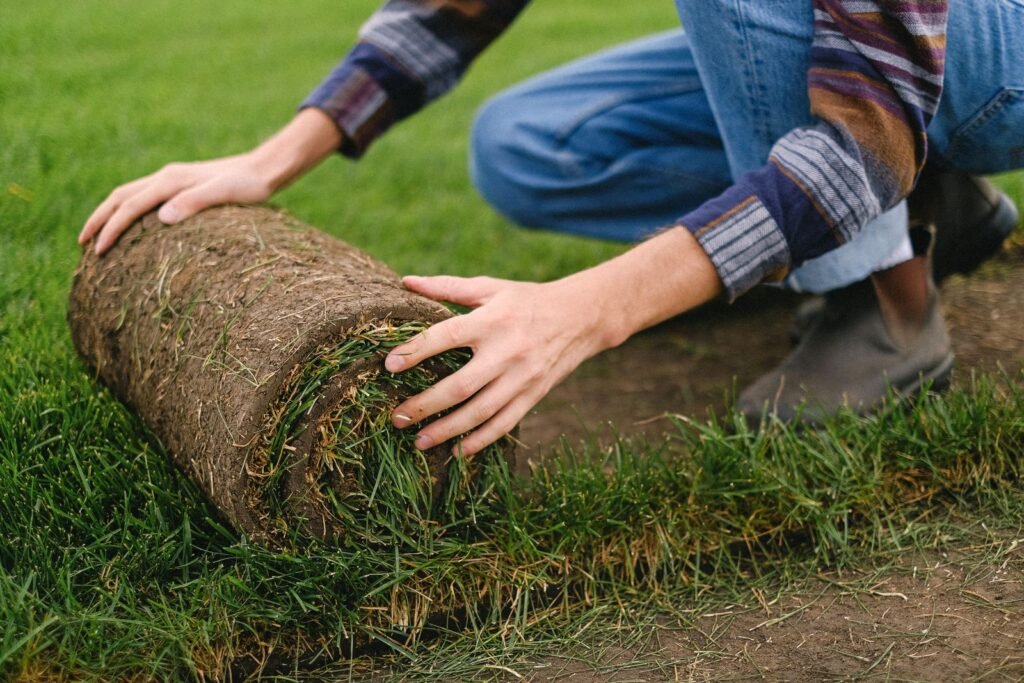
Lay sod the day it arrives if you can; if it has to wait, keep it shaded and watered. Lay the rolls in staggered rows, like brickwork, butting the edges tight with no gaps and no overlaps. Water it in right after laying, and keep it damp until the roots take hold.
Texas note
In Lubbock, both Bermuda and buffalo grass go brown and dormant in winter. That is normal, not dead — they green up again when the soil warms in spring. Do not try to water a dormant lawn back to green in January; it only wastes water. If you want green through the winter, overseed with annual ryegrass — the Grass Seed Calculator works out how much you need.
Frequently asked questions
How many rolls of sod do I need?
It depends on the area — for a 1,000 sq ft lawn with 10% waste, 110 rolls (1,100 sq ft ÷ 10 sq ft per roll). Type the area into the sod calculator above and it gives you the roll and pallet counts.
How many pallets of sod are in 1,000 square feet?
Three pallets, with the usual 10% waste. 1,000 sq ft × 1.10 = 1,100 sq ft, and 1,100 ÷ 450 = 2.44, which rounds up to 3 pallets.
How much does sod cost per pallet?
$150–$450 per pallet in 2026, or $0.30–$0.85 per sq ft. A 1,000 sq ft lawn runs $330–$935 for materials, and installed sod runs $1–$2.50 per sq ft nationally — Texas is about 9% below that.
Does sod go brown in winter?
Yes, in Texas. Both Bermuda and buffalo grass go dormant and brown in winter — that is normal, not dead. They green up again in spring when the soil warms. If you want a green lawn through winter, overseed with annual ryegrass.
Can you lay sod in November?
Yes — in Texas you can lay sod in November, as long as the ground is not frozen. But expect a dormant, brown lawn until spring: warm-season grasses like Bermuda stop growing as the soil cools, so the sod roots very slowly and may not fully anchor until spring. Keep it watered during dry spells, but never run sprinklers when temperatures are at or below freezing. St. Augustine is the least cold-tolerant, so it needs extra care. Texas A&M notes sod can go down any time of year, with spring, late summer and fall the preferred seasons — and if the yard is bare mud or eroding, a November install still makes sense; otherwise waiting for spring is usually the better call.
Should I order extra sod?
Yes — 10% extra is the usual cutting waste for a square or rectangular lawn, and 15% for a curved or sloped one. Sod does not keep, so order for the day you lay it.
Is sod cheaper than seed?
No — sod costs more up front than seed, but it gives you a finished lawn the day it is laid. Seed is cheaper and lighter to carry, but it takes weeks to fill in and needs steady watering while it gets going. The Grass Seed Calculator works out how much seed a lawn the same size would take.
How many sod slabs do I need?
One slab covers about 2.67 sq ft, so a 450 sq ft pallet holds roughly 168 slabs. Divide your square footage by 2.67, then add 10% waste (15% for curves and slopes) — same waste rule as rolls.
Related tools
Try the Topsoil Calculator for the 4–6 inches of soil under new sod, the Cubic Yard Calculator for soil and mulch by volume, the Grass Seed Calculator if you would rather seed than sod, and the Sand Calculator for levelling low spots before laying.
Sources and methodology: The 27 cubic feet in a cubic yard is the US customary definition (National Institute of Standards and Technology). One pallet of sod covers about 450 sq ft and one roll about 10 sq ft — the shared density table values used across this site. Prices are 2026 US planning ranges.
Calculation notice: Results are estimates for planning and ordering. Actual area depends on how the lawn is shaped and how much is cut off at the edges. All prices are 2026 planning ranges, not quotes.
Need a pro in Lubbock?
If you are in Lubbock, TX and would rather have sod delivered and laid than do it yourself, see landscaping and lawn care services. This sod calculator above still tells you how much you need, so you can check any quote against your own numbers.