
Paver Calculator — How Many Pavers Do You Need?
Pavers, base gravel and sand — for one patio in a single pass.
4×8 to 12×12 and custom sizes | 4 in or 6 in base | Polymeric sand by joint | 2026 costs
Paver Calculator
Concrete pavers are $3–$8 per sq ft for materials in 2026.
Enter your local bulk price for crusher run or #57 stone.
Bulk sand is $25–$60 per cubic yard in 2026.
Free — no sign-up.
Quick answer: A 12 × 16 ft patio needs 564 pavers (6×9, with 10% cuts), 2.73 cubic yards of base gravel, 0.65 cubic yards of bedding sand and 3 bags of polymeric sand. The pavers run $576–$1,536 in 2026. Use the paver calculator above — 4-inch base for a patio or walkway, 6 inches for a driveway.
How we check our math — reviewed November 9, 2026. Every formula is worked by hand against the US customary definition (National Institute of Standards and Technology) and the shared density table used across this site — base gravel about 1.41 tons per cubic yard, bedding sand 1.35 tons per cubic yard. Found a mistake? Tell us — we check every correction report and fix verified errors.
Rule of thumb: One cubic yard of base gravel covers about 81 sq ft at 4 inches deep and 54 sq ft at 6 inches. One cubic yard of bedding sand covers 324 sq ft at 1 inch. A 50 lb bag of polymeric sand covers about 75 sq ft of narrow joints.
A 12 × 16 ft patio (192 sq ft) with 6×9 pavers needs 564 pavers with the usual 10% cutting waste, 2.73 cubic yards of base gravel and 0.65 cubic yards of bedding sand, plus 3 bags of polymeric sand for narrow joints. The pavers run $576–$1,536 at 2026 material prices. This paver calculator works out pavers, base, sand and joint sand for a patio, walkway or driveway.
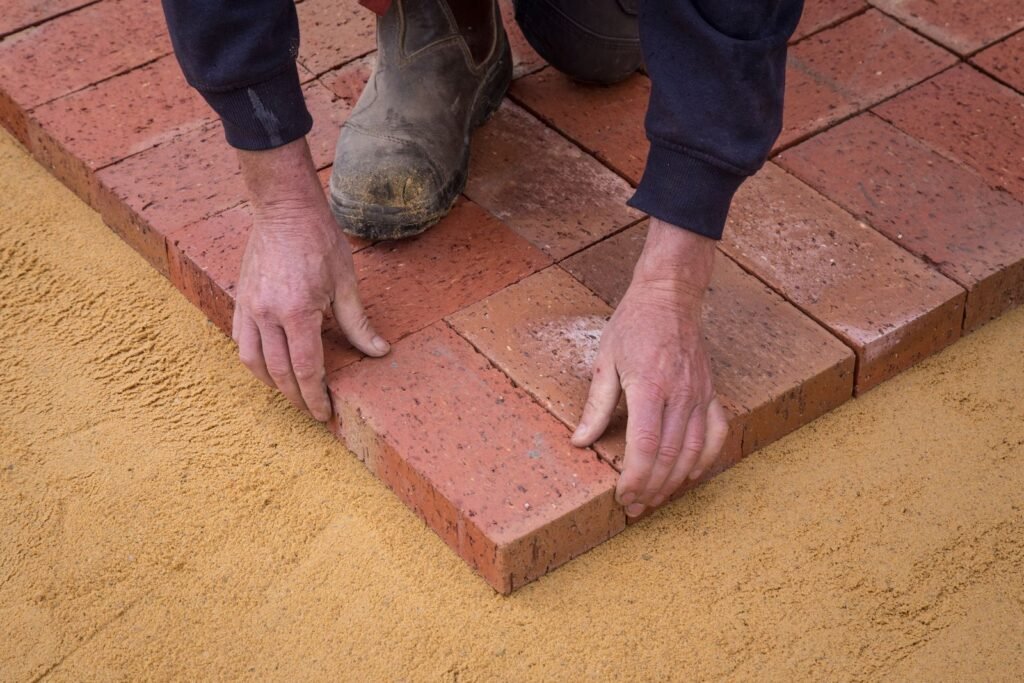
Volume notice: Pavers, base gravel and bedding sand are all ordered by volume or by the square foot, not by weight. A cubic yard of base gravel weighs about 1.41 tons (crusher run) and a cubic yard of dry bedding sand about 1.35 tons — useful if the yard weighs the load, but you still order it by the yard.
How the paver calculator works
The paver calculator works in four steps. First, pavers: area in square feet ÷ the area of one paver, then × 1.10 for the usual 10% cutting waste — 1.15 for diagonal or herringbone — rounded up. Second, base gravel: area × base depth in inches ÷ 324, then × 1.15 for the compaction allowance, rounded to two decimals. Third, bedding sand: area × 1 inch ÷ 324, then × 1.10, because the bed is always 1 inch deep and screeded level. Fourth, polymeric sand: area ÷ the coverage of one 50 lb bag (75 sq ft for narrow joints, 40 for wide, 25 for flagstone), rounded up. Use the paver calculator above to check your own numbers.
Worked example — patio
A patio 12 ft by 16 ft with 6×9 pavers. Area: 12 × 16 = 192 sq ft. One 6×9 paver covers 0.375 sq ft, so the patio takes 192 ÷ 0.375 = 512 pavers before cuts; with 10% cutting waste, 512 × 1.10 = 563.2, rounded up to 564 pavers. Base gravel (4 in): 192 × 4 ÷ 324 = 2.37 yd³, × 1.15 = 2.73 yd³ to order. Bedding sand (1 in): 192 × 1 ÷ 324 = 0.59 yd³, × 1.10 = 0.65 yd³ to order. Polymeric sand (narrow joints): 192 ÷ 75 = 2.56, rounded up to 3 × 50 lb bags. Pavers at $3–$8 per sq ft: 192 × $3–$8 = $576–$1,536.
Worked example — walkway
A walkway 3 ft by 30 ft with 4×8 pavers. Area: 3 × 30 = 90 sq ft. One 4×8 paver covers 0.222 sq ft, so the walkway takes 90 ÷ 0.222 = 405 pavers before cuts; with 10% cutting waste, 405 × 1.10 = 446 pavers to order. Base gravel (4 in): 90 × 4 ÷ 324 = 1.11 yd³, × 1.15 = 1.28 yd³ to order. Bedding sand (1 in): 90 × 1 ÷ 324 = 0.28 yd³, × 1.10 = 0.31 yd³ to order. Polymeric sand (narrow joints): 90 ÷ 75 = 1.2, rounded up to 2 × 50 lb bags.
The base is the patio
Most paver failures are base failures. The pavers themselves are just the wearing surface — the compacted gravel underneath carries the load. A patio or walkway needs 4 inches of compacted base gravel; a driveway needs 6 inches, because it carries cars. Compact the gravel in layers and check the grade away from the house so water runs off. Then screed exactly 1 inch of bedding sand, lay the pavers the same day, and sweep polymeric sand into the joints. Skimp on the base and the pavers sink, shift and rock within a season.
Paver sizes
| Paver size | Sq ft per paver | Pavers per sq ft |
|---|---|---|
| 4 × 8 in | 0.222 | 4.50 |
| 6 × 6 in | 0.25 | 4.00 |
| 6 × 9 in | 0.375 | 2.67 |
| 12 × 12 in | 1.0 | 1.00 |
Base and sand by project
| Project | Base depth | Base gravel per 100 sq ft | Bedding sand per 100 sq ft |
|---|---|---|---|
| Patio | 4 in | 1.42 yd³ | 0.34 yd³ |
| Walkway | 4 in | 1.42 yd³ | 0.34 yd³ |
| Driveway | 6 in | 2.13 yd³ | 0.34 yd³ |
Coverage per cubic yard by depth
| Depth (inches) | Sq ft per yard |
|---|---|
| 1 | 324 |
| 2 | 162 |
| 3 | 108 |
| 4 | 81 |
| 6 | 54 |
| 8 | 41 |
Polymeric sand by joint width
| Joint width | Coverage per 50 lb bag | Bags per 100 sq ft |
|---|---|---|
| Narrow (1/8–1/4 in) | 75 sq ft | 2 |
| Wide (3/8–1/2 in) | 40 sq ft | 3 |
| Flagstone or irregular | 25 sq ft | 4 |
Waste allowance by project type
| Project type | Extra to order |
|---|---|
| Straight patio or walkway | +10% |
| Diagonal or herringbone pattern | +15% |
| Lots of curves and cuts | +15% |
| First time laying pavers | +10–15% |
Texas note
West Texas wind pulls loose joint sand out of paver joints, which is why polymeric sand is worth using here — it sets hard and holds the joint together instead of blowing away. Light-coloured pavers stay cooler under the West Texas sun and are easier to walk on barefoot in summer. Grade the base away from the house so summer storm water runs off the patio, and keep the bedding sand damp until the pavers go down — a bare sand bed ripples in the wind if you leave it overnight.
Frequently asked questions
How many pavers do I need for a 12×16 patio?
564 with 6×9 pavers and the usual 10% cutting waste (512 before cuts). Use the paver calculator above — pick 6×9 for the size and straight runs for the waste — and it also gives you the base gravel, bedding sand and polymeric sand for the same patio.
How deep should the base be under pavers?
4 inches of compacted gravel for a patio or walkway, 6 inches for a driveway. The base carries the load — the 1 inch of bedding sand on top only levels the pavers.
Can you install pavers in winter?
Yes — but only while the ground isn’t frozen. Paver industry specs say never to build on a frozen subgrade or bedding sand, or with frozen materials, because frozen ground can’t be compacted properly and the base settles unevenly when it thaws. Polymeric sand has its own limit: most brands need temperatures above 32°F to set (Alliance Gator G2), and some need above 50°F for 48 hours (Techniseal NOCO) — so follow the label on your bag. The sand also has to dry fully before it hardens, which is slow in cold, damp weather. Concrete edge restraints cure slowly in the cold too and need protection from freezing. In Lubbock, winter days are often mild enough — December highs average around 54°F — so a dry, unfrozen day works fine. But once the ground freezes or a hard freeze is forecast, wait for spring: laying pavers in a mild spell is fine, laying them on frozen ground is not.
How much polymeric sand do I need?
One 50 lb bag covers about 75 sq ft of narrow joints (1/8–1/4 inch), 40 sq ft of wide joints (3/8–1/2 inch), or 25 sq ft of flagstone or irregular joints. A 192 sq ft patio with narrow joints takes 3 bags.
How much does a paver patio cost?
Concrete pavers run $3–$8 per sq ft for materials, and $12–$40 per sq ft installed. The materials for a 192 sq ft patio run $786–$1,791 at 2026 range prices, before delivery. Polymeric sand is $25–$40 per 50 lb bag.
Can I lay pavers on sand alone?
No. Sand only levels the pavers; it does not carry the load. Without a compacted gravel base underneath, pavers sink and shift. The base is the patio — 4 inches for a patio or walkway, 6 inches for a driveway.
Why do my pavers move?
Usually the base. A base that is too thin, not compacted, or has no edge restraint lets pavers rock and drift. A base that grades toward the house also lets water sit under the pavers. Fix the base first — the pavers on top will follow.
Related tools
Try the Gravel Calculator for the compacted base, the Sand Calculator for bedding sand, the Cubic Yard Calculator for any material by volume, and the Concrete Calculator for a slab or footing under the same patio.
Sources and methodology: The 27 cubic feet in a cubic yard is the US customary definition (National Institute of Standards and Technology). Base gravel about 1.41 tons per cubic yard (crusher run) and dry bedding sand 1.35 tons per cubic yard are the shared density table values used across this site. Prices are 2026 US planning ranges.
Calculation notice: Results are estimates for planning and ordering. Actual quantities depend on how the ground is shaped, compaction, and the material delivered. All prices are 2026 planning ranges, not quotes.
Need a pro in Lubbock?
If you are in Lubbock, TX and would rather have a patio built than lay it yourself, see landscaping and lawn care services. This paver calculator above still tells you how much material the job needs, so you can check any quote against your own numbers.